Human Skills in the AI Era: Why Emotional Intelligence and Leadership Training Are Now a High-ROI Investment
AI is no longer a future trend. It is already reshaping how work gets done across Australia and New Zealand.
Yet many organisations are learning a difficult lesson: simply rolling out AI tools, licences and prompt-engineering sessions does not automatically create better performance. Technology can generate outputs faster, but people still need to interpret those outputs, collaborate effectively, make decisions, manage risk and lead teams through change.
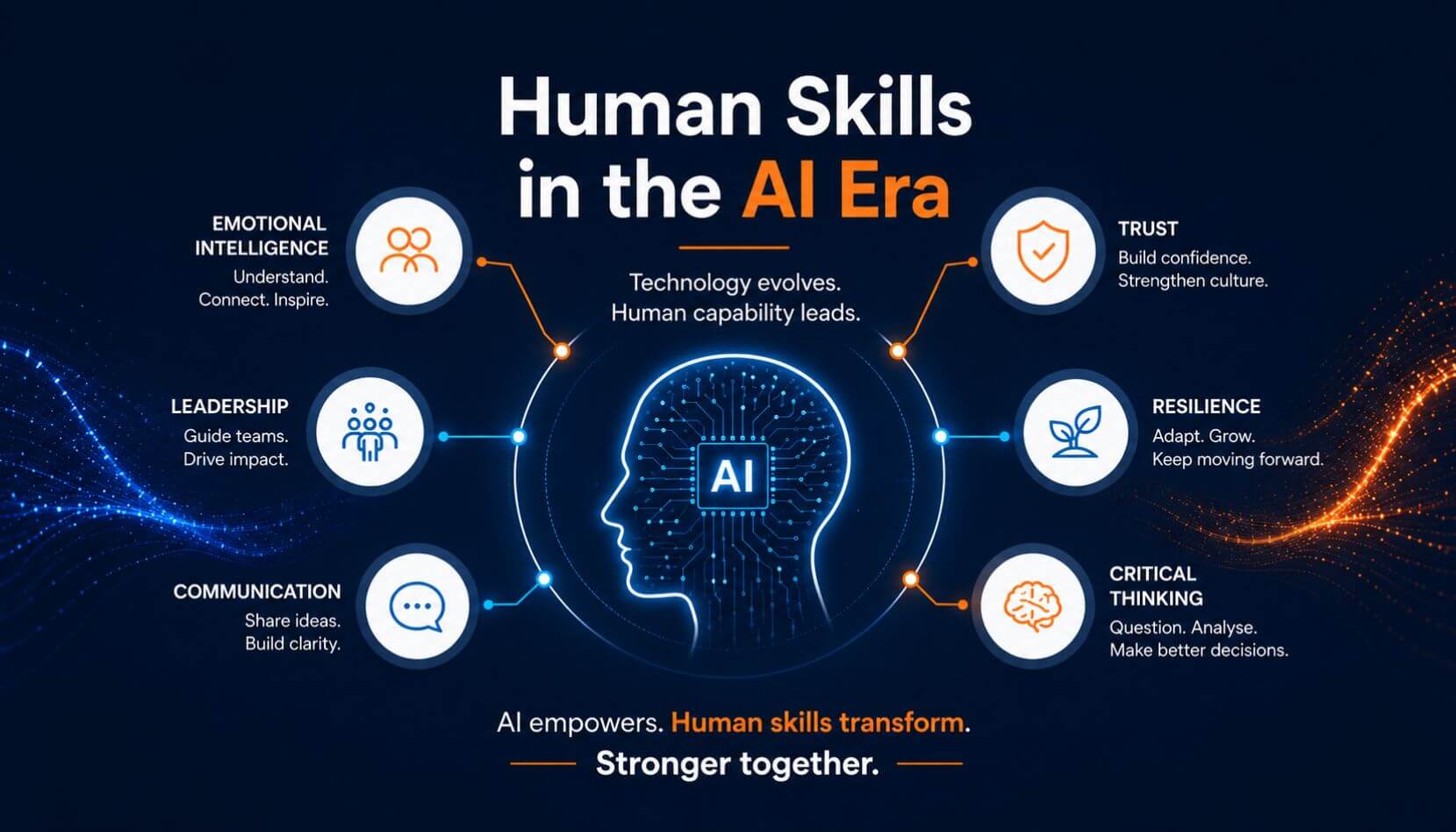
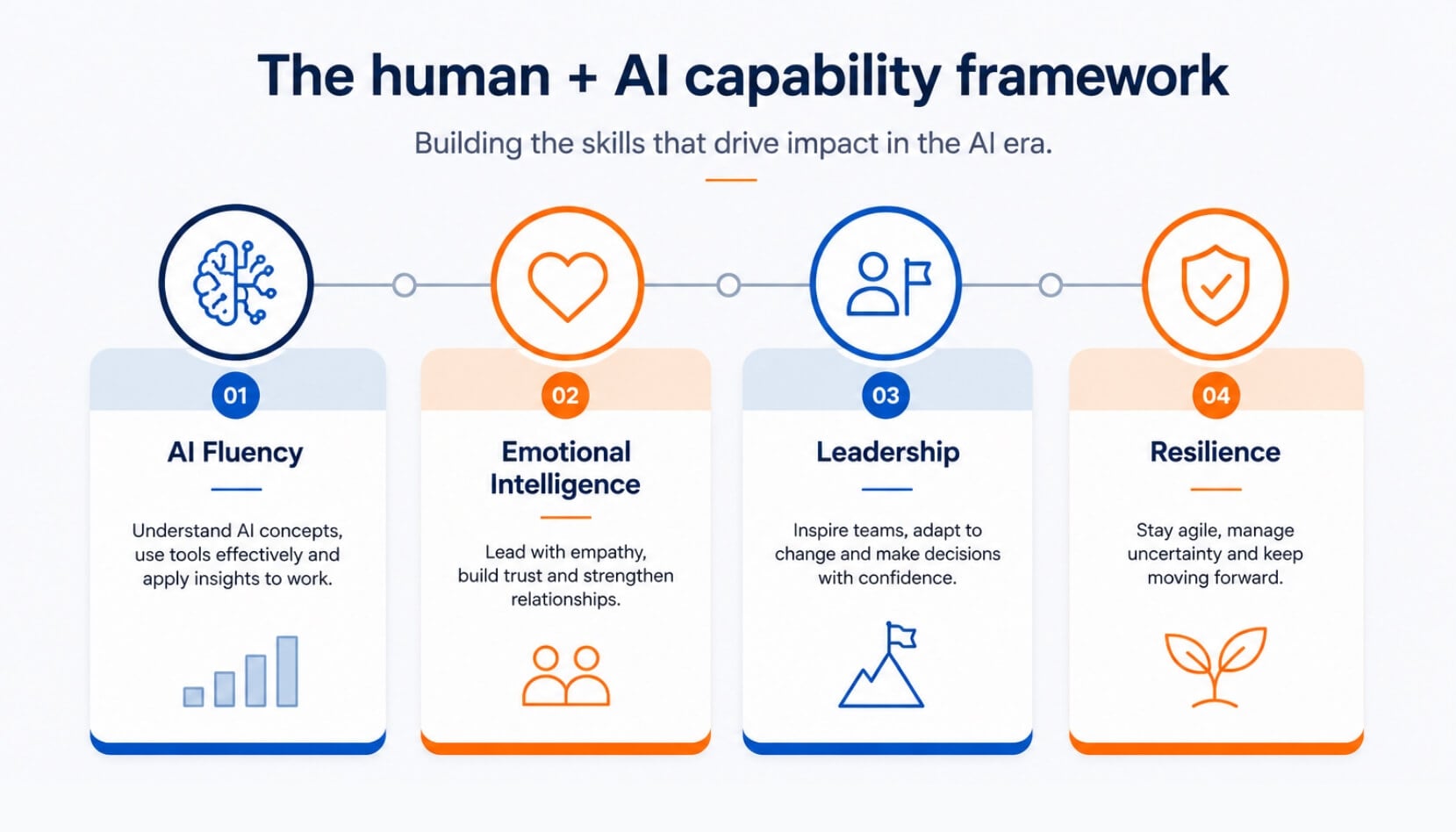
The organisations pulling ahead are not only the ones with the most advanced AI systems. They are the ones deliberately building the human skills that make AI adoption work: emotional intelligence, adaptive leadership, resilience, communication, ethical judgement and the ability to bring people through uncertainty.
TL;DR: AI is changing the skills mix organisations need. Technical AI capability matters, but it is not enough on its own. The highest-value workforce development programs now combine AI fluency with emotional intelligence, communication, leadership, resilience and critical thinking.
For Australian and New Zealand organisations, investing in human skills helps teams adopt AI faster, reduce resistance, improve collaboration and make better decisions when technology introduces uncertainty.
1) The misconception: AI is not replacing human skills. It is raising their value
A common assumption is that AI will make many human capabilities less important. In practice, the opposite is happening in many workplaces.
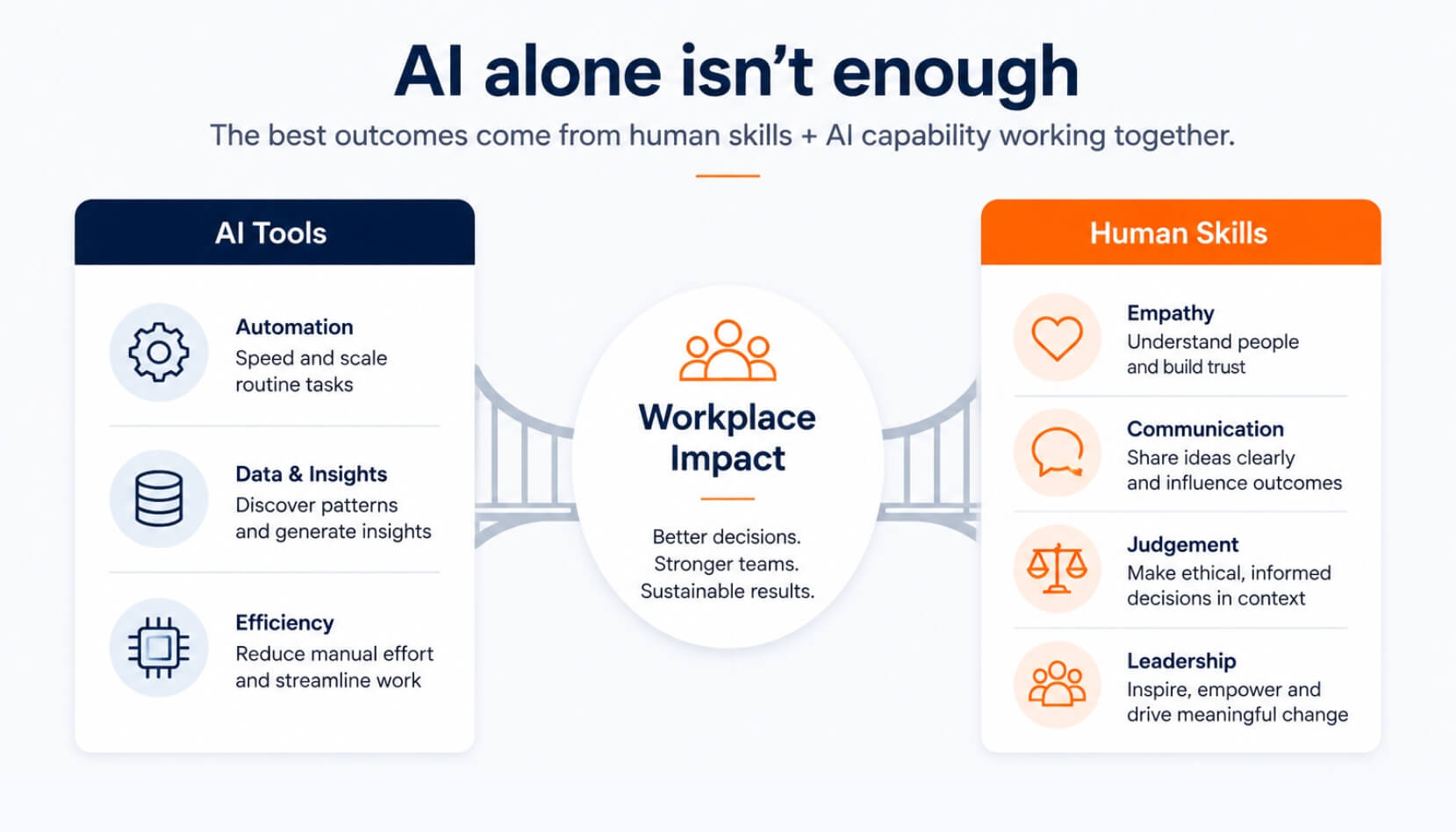
Generative AI can draft content, summarise information, analyse data, produce options and automate routine tasks. But it cannot fully replace empathy, trust, ethical judgement, stakeholder management, organisational context or the ability to lead people through uncertainty.
Practical example: AI can generate a change communication plan. A leader still needs to understand how the team will react, where resistance may appear, which stakeholders need reassurance, and how to communicate the change in a credible way.
This is the shift many organisations are now responding to. AI changes what work looks like. Human skills determine how well people perform in that new environment.
2) What the 2025–2026 data shows
Recent workforce research points to a clear conclusion: organisations need technical AI skills and human skills together. One without the other creates a capability gap.
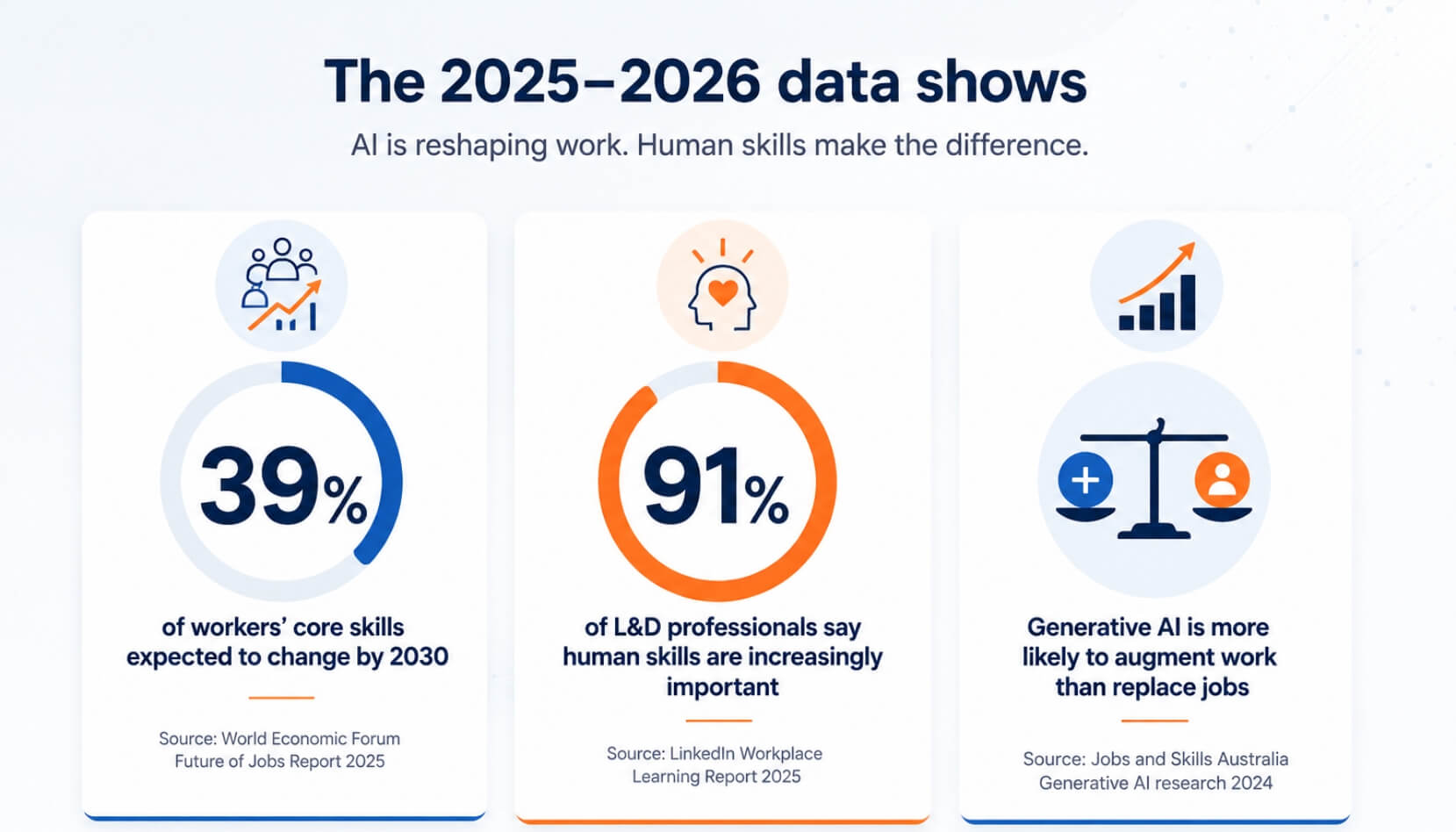
The World Economic Forum expects 39% of workers' core skills to change by 2030, making continuous learning a practical workforce requirement.
Leadership and social influence have recorded one of the strongest increases in importance, alongside resilience, flexibility and agility.
LinkedIn's Workplace Learning Report 2025 found that 91% of L&D professionals say human skills are increasingly important.
Jobs and Skills Australia has found generative AI is more likely to augment work than replace jobs outright, increasing the need for complementary human capability.
The implication for HR, L&D and senior leaders is straightforward: AI capability should not be treated as a software rollout only. It should be treated as an organisational capability program.
3) Why emotional intelligence has become a strategic priority
Emotional intelligence is no longer just a desirable leadership trait. In AI-enabled workplaces, it has become a core capability for managing change, building trust and improving team performance.
AI introduces faster workflows, new decision points, higher ambiguity and new ethical grey areas. People need to understand their own responses to disruption, communicate clearly with others and manage tension when change feels uncomfortable.
- Recognise and manage reactions to change instead of letting uncertainty drive resistance.
- Build psychological safety so employees can ask questions, raise risks and learn new tools without fear.
- Communicate with empathy when AI changes responsibilities, workflows or expectations.
- Handle conflict constructively when teams disagree about AI outputs, priorities or ways of working.
- Make better judgements when AI provides information but people still need to decide what is appropriate.
This is why emotional intelligence training is moving from the “nice to have” category into a more strategic workforce development priority.
4) Leadership in the age of AI: the skills that move the needle
Traditional leadership models built for stable, predictable environments are becoming less effective. AI-enabled work is faster, more fluid and often less certain.
Leaders now need to create clarity when tools, processes and expectations are changing. They need to help teams use AI responsibly while keeping people engaged, included and accountable.
Key point: As AI handles more of the “what” and “how”, leaders become even more responsible for the “why”, the “who” and the quality of human decision-making.
5) The Australian and New Zealand context
Australia and New Zealand face a specific mix of pressures that make human skills development urgent: productivity expectations, hybrid work, digital transformation, AI adoption, talent retention and skills shortages.
Jobs and Skills Australia has highlighted that AI will change work across industries, but it also points to the need for complementary human skills. In New Zealand, workforce commentary is making a similar point: as automation takes over routine tasks, employers place greater value on emotional intelligence, creativity, critical thinking and relationship-building.
The challenge is not only adopting AI tools. It is preparing teams to use them safely, productively and with good judgement.
The human advantage is increasingly tied to communication, adaptability, leadership and relationship-building.
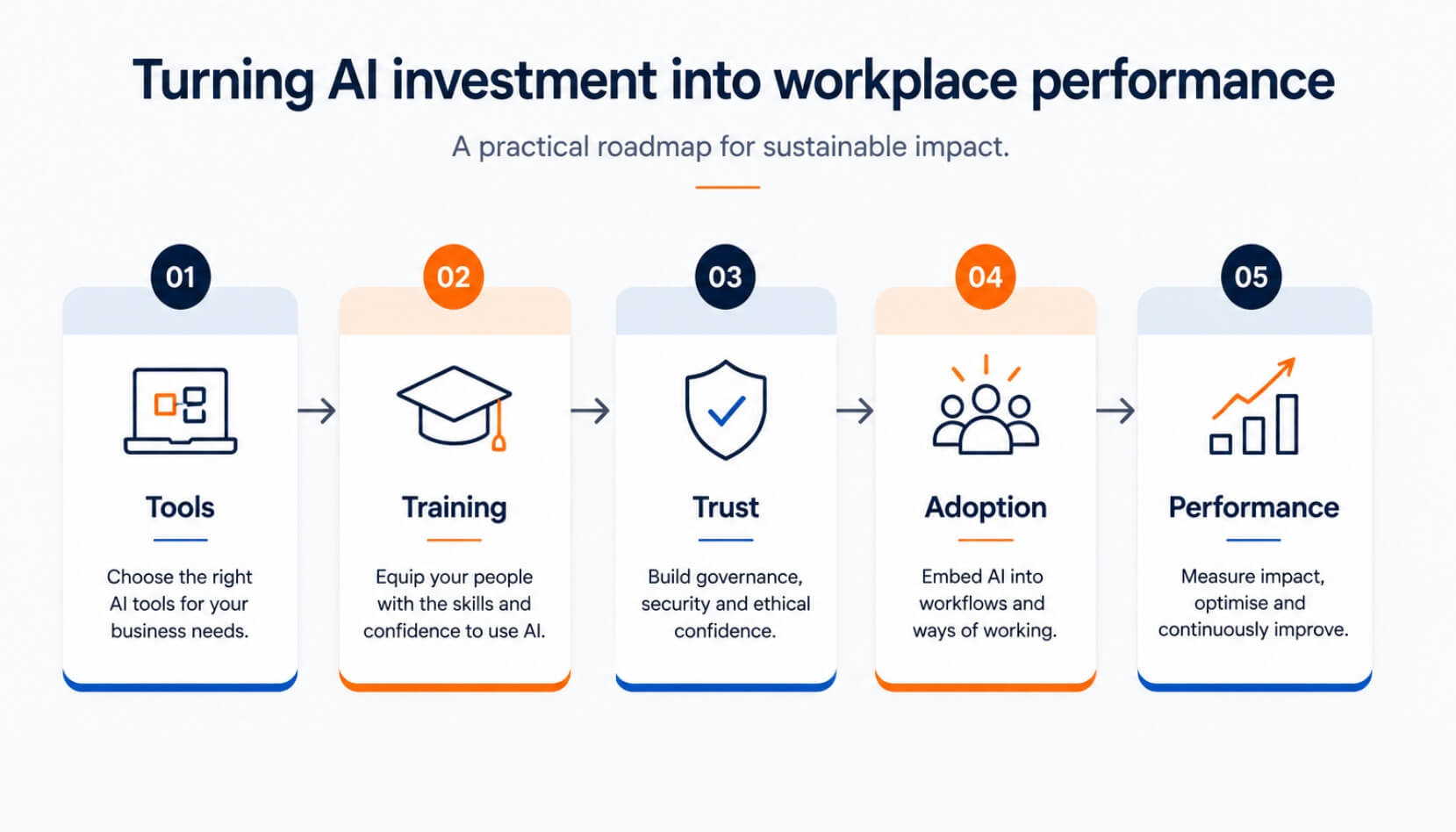
The lesson is simple: technology amplifies both strengths and weaknesses. Strong human skills turn AI investments into better performance. Weak human skills can turn them into expensive experiments with limited adoption.
6) Practical framework: how leading organisations are responding
The strongest AI adoption programs are not built around technology alone. They combine digital capability, leadership capability and practical behaviour change.
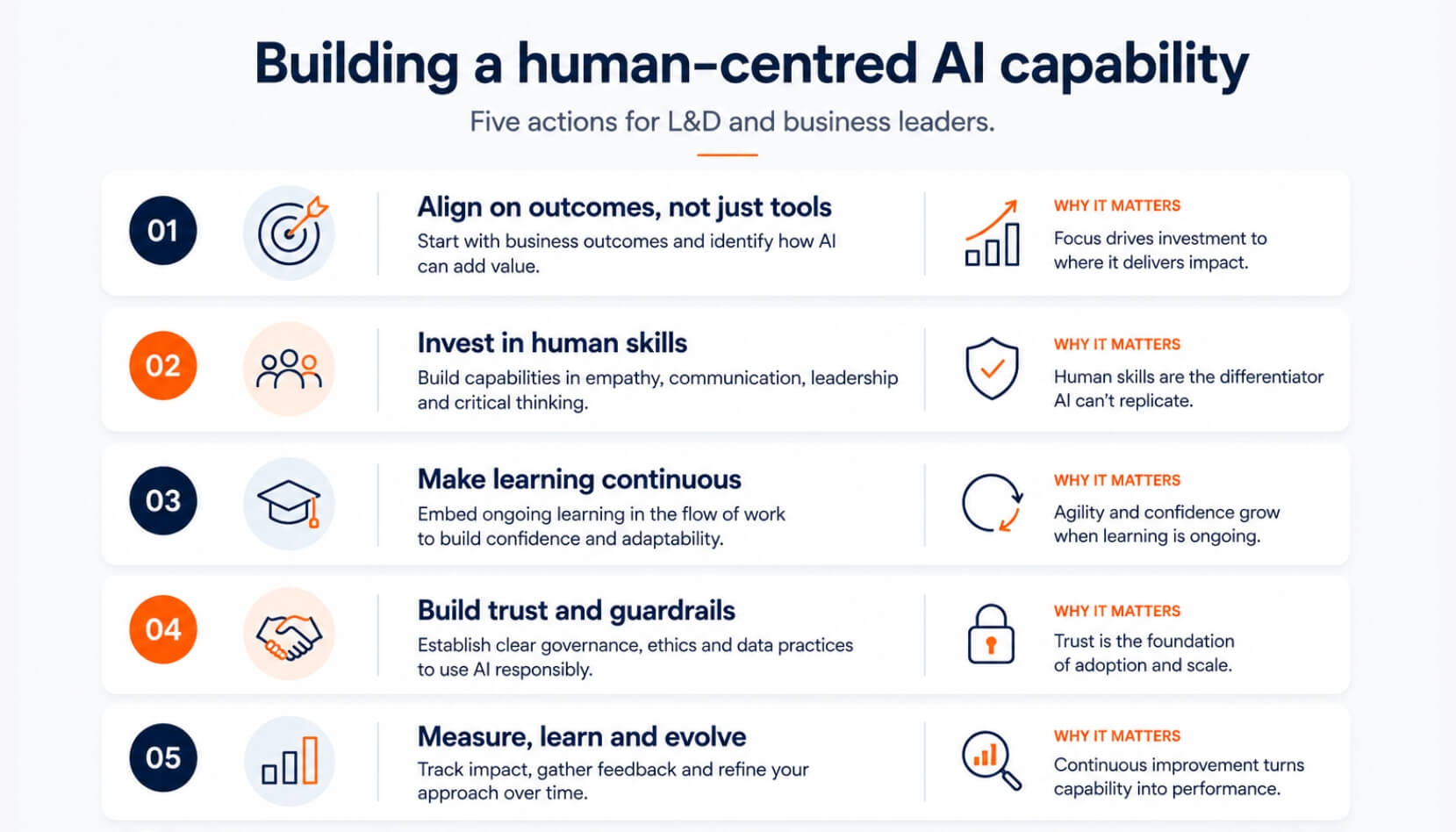
- Audit both sides of capability: assess AI fluency alongside emotional intelligence, leadership, resilience and communication.
- Prioritise people managers first: managers have the greatest influence on team behaviour, adoption and confidence.
- Choose applied training: short, practical programs create faster workplace transfer than abstract theory.
- Measure adoption and behaviour: track confidence, usage, psychological safety, decision quality and follow-through, not only training attendance.
- Build internal capability: use Train the Trainer programs to scale consistent human skills development across teams.
7) Where professional development training fits
Professional development training is most valuable when it connects directly to workplace problems: change fatigue, communication gaps, poor meeting behaviour, low psychological safety, conflict, resistance to new tools or inconsistent leadership capability.
For organisations planning AI transformation, the priority is not to replace technical training. It is to support it with the human capabilities that make adoption sustainable.
Good habit: Treat human skills training as part of your AI adoption roadmap, not a separate HR activity. The return improves when managers and teams can immediately apply the learning to current workplace changes.
8) FAQs (expand to read)
These are common questions from HR, L&D and business leaders planning professional development in the AI era.
Why are human skills more important when AI is improving?
AI can automate or accelerate many tasks, but people still need to collaborate, make decisions, communicate with stakeholders, manage risk and lead change. Human skills help organisations turn AI outputs into better workplace outcomes.
Is emotional intelligence training relevant for technical teams?
Yes. Technical teams still need to explain recommendations, manage stakeholders, handle conflict, collaborate across functions and make sound decisions under uncertainty. Emotional intelligence supports those behaviours.
Should organisations train managers before broader teams?
In many cases, yes. Managers influence daily behaviour, team confidence and adoption. Training managers first can help create clearer communication, better coaching and stronger support for broader AI-related change.
How does resilience training support AI adoption?
AI adoption often changes workflows, expectations and confidence levels. Resilience training helps employees respond to uncertainty, manage pressure and adapt constructively rather than disengaging or resisting change.
Can Nexacu deliver this training for corporate teams?
Yes. Nexacu offers public courses as well as corporate and onsite training options. Organisations can choose focused programs for managers, teams or internal trainers depending on their capability goals.
9) The bottom line
AI will continue to advance rapidly. The organisations that benefit most will not be the ones that invest in technology alone. They will be the ones that build the human capability needed to use that technology well.
Emotional intelligence, adaptive leadership, resilience and communication are no longer peripheral skills. They are central to making AI work for people, teams and organisations.
The question is no longer whether organisations can afford to invest in these skills. It is whether they can afford not to.
Build practical capability in emotional intelligence, leadership and resilience
Nexacu's Professional Development courses help Australian and New Zealand teams strengthen the human skills that support AI adoption, change readiness and day-to-day workplace performance.
- Emotional Intelligence
Self-awareness, empathy and communication
- Leadership and Management
Influence, clarity and team performance
- Resilience and Change
Adaptability in changing workplaces
Note: AI adoption priorities vary by organisation, industry and workforce maturity. For best results, align professional development programs with your organisation's current AI roadmap, people strategy and change-management priorities.